A practical pipeline for using image and video models, FFmpeg, Pillow, and local scripts to turn animation footage into clean, transparent sprite sheets.
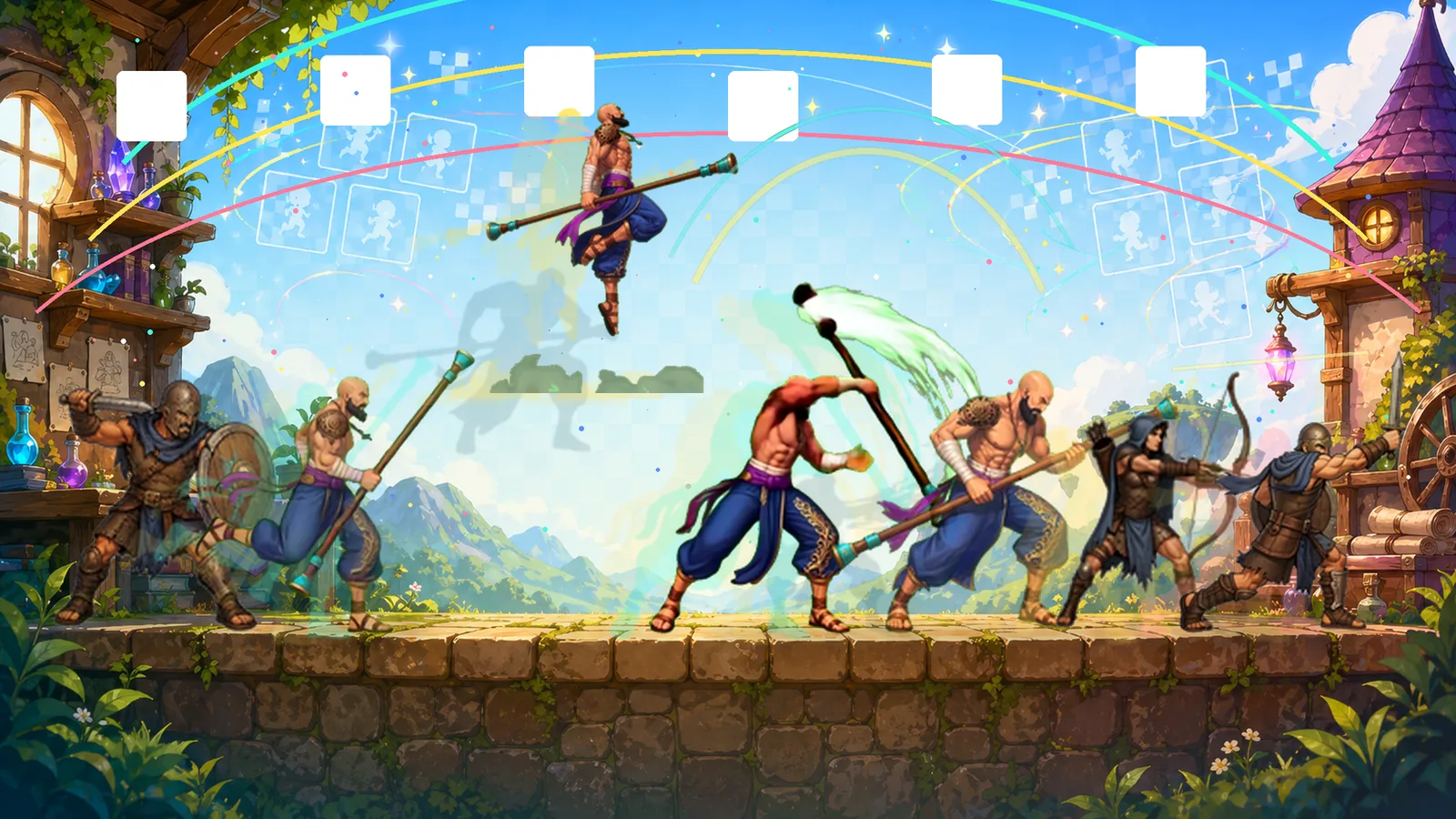
Preface
Like a lot of the video game enthusiasts, there came a time when I could no longer resist my nature and I prompted Codex to make me a game.
I ran into some issues with animations Codex made for me and this is how I solved them.
If you are here just for the pipeline, feel free to skip the next section. If you're interested in the journey and not only in the destination, read on!
The Journey
Long before AI existed, I dipped my toe into game dev. Like most, I eventually settled in Unity and spent a few years working with it. I had multiple ideas for completely different games, starting from a point and click adventure to co-op story driven RPG.
I tried building solo, I tried building with friends. My personal time limitation was a constraint, but not a big enough hurdle to keep me from coding a lot of the game's systems. The biggest issue for me was the graphics.
Though I have grown up with the 90s games, I was never a fan of pixel art and always wanted my games to have a stylized look. They didn't have to be on the cutting edge of graphics. But they had to have character.
I've looked into hiring artists, but even a concept art piece would set me back way too much money for my wallet at the time. I've looked into making graphics myself. Drawing was never my thing, though it turned out I could sculpt decently well in Blender. After only 150 hours I had a character!
A character that, as it turned out, I had no chance of using in a video game. A character that, as it turned out, was insanely difficult to animate even if I figured out the mesh problem. Long story short, another project was abandoned.
Fast forward to today, and Codex one-shots a game that I described in one paragraph. Now, I know what you're thinking: he's full of shit, nothing can get one-shotted, especially a game. And you would be partially right.
The game had basic graphics made of shapes and it wasn't too fun to play, but it worked!
Main character could run, jump, attack and had a magic attack. Enemies rushed the Core, stopped to attack the player or NPC defenders. There was a health pool, mana pool, resource pool, a losing condition and even a defeat animation! All the things we take for granted in the game were done for me from one prompt!
Absolute heaven! All I had to do was to create a few sprite sheets to replace the sticks and stones graphics. No big deal!
Uhh, yes a big deal! It wasn't that easy.
And if you've read this far you probably know where I ran into an issue. Image models cannot follow strict rules. Why does it matter? Because a sprite sheet must be laid out in a mathematical order so that the game engine can access each frame programmatically. In other words it must be divided into perfect frames and the character must be always in the middle of the frame. That last one is important or you'll get character jitters while the animation is playing.
On top of that, the background must be transparent and not all the models can handle that either!
I spent 2 days, dozens of prompt variations, reference grid variations and nothing worked! I was ready to give up... One thing that stopped me was the fact that the AI wrapper tools I tried for this specific task, did not always listen to what I wanted in my animation. There would be some super weird results even after my prompts were cleaned by their own AI helpers.
Thankfully, both of these issues (the framing and background transparency) were solved long ago, programmatically. Once I found that route, it wasn't long before I, with AI's help and guidance, had a couple of scripts that took a malformed product from the image model, and produced a solid sprite sheet with clean margins and a transparent background.
Huzzah! The day is won!
Nope. Celebrated early again.
Those of you who have tried using the image model to create sprite sheet frames will probably know where this is going. Those models don't understand walking. Or running. They don't get how legs work! You can tell them EXACTLY where each leg is supposed to be, how the foot is supposed to be turned, and they will still mess it up. Even in pixel graphics! I think the only style that was more or less spared is top-down, where there are only 2 variations of where the feet should be. Thank the wonder of AI science!
That was it, a dead end. I ran so many prompts I've lost count. I made 10 by 5 sprite sheets and tried selecting the frames that looked like they would be a decent progression from one another. Nothing worked well. Some attempts came close, but that is not a pipeline that I would care to use multiple times for sub-par results. And I would not recommend it to anyone.
A post on X saved me. A short reply to somebody having a similar problem as me. "use kling and just extract frames" (I'm paraphrasing here, I saw it 2 weeks ago and I can't find the author or the post)
What?! I originally dismissed it. It sounded like the author suggested for me to kill a mosquito with an axe. But then I looked into it. And it was a viable solution! Video models do not have the same issue with legs! In fact, they do not have an issue with any motion. And frame extraction was solved so long ago that I didn't even have to look for a tool, it jumped into my lap! Moreover, I already had 99% of the remaining pipeline completed. All I had to add is a script for stitching together frames from multiple files, which Codex wrote in minutes!
There are a few things to consider when prompting a video model to make sure the resulting video is viable, but it wasn't hard to figure out, and I'll drop the tips below.
Whew! Victory!
I am extremely happy with how the pipeline works. I've even experimented with stitching some animations together and it worked quite well; although it needed some tuning in terms of new frame validation. But Codex does an amazing job once this workflow is wired into the project.
Without further ado, I hope you enjoy the workflow below!
The Pipeline
This is the technical version of the workflow. This was mostly written by an AI with my writing sprinkled throughout to provide tips and commentary. I recommend for you to at least read the first 2 steps to understand how to prompt the image and video models to get the best results. I curated these guidelines from dozens of iterations and you can dump them into your agent and make it convert your simple prompts into ones ready for the models. Steps 3 and beyond are meant for your coding agent. I have tested and perfected them through multiple clean runs. Copy, paste, tell your agent to build the scripts as described and run the workflow on your videos!
There is a Tips and Tricks section at the bottom. It is meant for you, the reader.
Good luck, have fun!
1. Create the first animation-safe pose
Create one full-body character image with an image model, such as GPT Image 2 or Nano Banana 2. This image becomes the first frame for the video model.
Use exact chroma green:
- Hex:
#00FF00 - RGB:
0,255,0
The background must be perfectly flat. No shadows, floor, gradients, props, lighting falloff, or background objects. The character design must not use this green anywhere, including clothing, gems, magic, outlines, antialiasing, or glow.
Frame the character for animation, not as a portrait:
- Full body visible from head to feet
- Full weapon, cape, hair, loose cloth, and accessories visible
- No cropping
- Character centered in frame
- Generous empty margin on all sides
- No part of the character enters the outer 20-30% border area
- For idle/game animation, character height should usually be about 40-50% of the canvas
This matters because video models often animate wider than the first pose suggests. If a weapon, cape, hand, foot, hair, or effect starts near the edge, Kling may push it out of frame once motion begins.
For any animation other than idle, I usually create a transition pose with the image model before going to video. Give the image model the base character reference, then ask for the first frame of the new animation as a small transition away from idle. Do not ask for the most extreme pose first. This helps attacks, runs, jumps, casts, hits, and landings flow naturally instead of snapping into a disconnected stance.
For very simple pixel sprites, this transition pose can be the most important control step. For example, with a tiny classic RPG walk cycle, first create a walking-pose image: one foot shifted a few pixels, the other foot shifted back, slight knee bend, tiny weapon/shield arm bob, same view, same scale, same background. Then use that image as Kling's first frame with a short prompt. Simple drawings often need less prompt engineering, not more.
The image prompt should specify:
- One character only
- Full-body 2D game character
- Exact starting pose
- Camera/view angle
- Character centered in frame
- Animation-safe margins
- Full weapon/effects visible
- Clean readable silhouette
- Stable design with clearly separated limbs
- Flat
#00FF00background only - No text, watermark, border, shadow, floor, props, gradients, or extra effects
After generation, verify that the background is actually exact #00FF00. If the model creates a soft green gradient or near-green pixels, flatten the border-connected background to exact #00FF00 before using the image for animation. Reject or fix any image with cropped limbs, cropped weapons, portrait framing, shadows, green on the character, extra props, extra characters, or important pixels near the edge.
2. Animate that pose in Kling
Use the image-model result as Kling's first frame. The output is controlled source footage for a sprite pipeline, not cinematic video.
Kling usually gives you one prompt field, so put the motion, preservation rules, camera rules, background rules, and avoid constraints into one copy-paste prompt. Do not rely on a separate negative prompt unless your tool actually provides one.
Scale the prompt to the asset. For simple drawings and tiny pixel sprites, first make a transition pose image, then use a short literal Kling prompt. Long direction-lock prompts can give Kling more ideas to reinterpret, causing travel, rotation, or redesign.
For simple classic RPG pixel sprites, avoid phrases like top-down 3/4 or isometric unless the first frame is truly diagonal. Those phrases can make Kling rotate the character or walk in different directions. Prefer wording like:
Use the uploaded image as the exact first frame.
Animate a tiny retro RPG sprite marching in place.

Keep the character pinned to the center of the screen.
Keep the same front-facing view for the entire clip.
The character must not turn, rotate, face diagonally, face sideways,
move forward, move backward, or move across the screen.

Only animate a simple two-step pose cycle:
the feet alternate a few pixels, the knees bend slightly,
and the weapon arm and off-hand/shield arm bob slightly.

Keep the head, chest, body angle, equipment sides, size, colors,
and pixel-art design the same.

Locked camera.
Flat #00FF00 green background stays unchanged.
No shadows, no floor, no effects, no blur, no new details, no redesign.
For more complex animations, the Kling prompt can be more mechanical. Include only the constraints that change the pixels:
- Use the uploaded image as the exact first frame
- Preserve character design, outfit, proportions, weapons, face, and 2D art style
- Describe the visible action in plain body-motion language
- Locked camera
- No zoom, pan, rotation, cuts, shake, dolly, or depth movement
- Character stays centered and the same size on screen
- Full body, weapons, and effects stay inside the frame
- Fixed facing direction with no yaw into neighboring directions
- Flat
#00FF00background with no floor, shadows, gradients, lighting changes, props, text, watermark, or motion blur
Do not describe the action vaguely.
Bad:
fast overhead sword slash
Good:
Use the uploaded image as the exact first frame.
Create an overhead sword attack.

The character makes a small weight shift,
raises the sword overhead,
pauses briefly in anticipation,
steps forward slightly,
strikes downward,
follows through,
then returns toward the ready stance.

Keep the camera locked,
the character centered,
the full body and sword inside the frame,
and the flat #00FF00 background unchanged.
For isometric walks, be careful not to imply travel through depth. Use walk-in-place, say the character faces the direction, and explicitly prevent dolly movement or size change. For cardinal south/down walks, forbid yaw into south-east or south-west if Kling starts drifting.
For vertical animations such as jump, fall, and landing, generate the body motion cleanly first. Add landing dust, takeoff wind, or other vertical effects as separate overlay animations. Foot-level effects can make Kling drift the character up or down inside the frame.
Be careful using the same image as both the first and final frame. Sometimes the model interprets that as "hold this image" and creates a still video. If needed, skip the final-frame input, then choose a good ending frame from the generated footage.
If the motion is good but the ending does not connect back to idle or into the next animation, do not automatically rerun the whole video. Ask an image model for one or a few bridge frames. Image iterations are often cheaper and faster than another video generation.
3. Extract full-resolution frames from the video
Create this script as tools/extract_frames_ffmpeg.py.
If you are giving this section to a coding agent, ask it to create a deterministic local Python CLI wrapper around ffmpeg and ffprobe (system command-line tools from the FFmpeg project; ffprobe ships with FFmpeg; install with Homebrew/apt/winget or from ffmpeg.org/download.html, not pip/npm). No APIs, no secrets, no hosted services. The script's job is to turn one video into a numbered folder of full-resolution PNG frames and a JSON report.
Use whatever folder structure you like. In the examples below, placeholders mean:
<source-video>: the animation video you downloaded from the video model<run-dir>: a temporary working folder for this one animation, such aswork/runs/2026-04-28_mage_attack_01<character>: your character name, such asmage<animation>: your animation name, such asattack_01<frame-count>: usually12or24
Implementation contract:
- script path:
tools/extract_frames_ffmpeg.py - dependencies: Python standard library plus system
ffmpegandffprobe - input: one video file
- output: one directory of ordered PNG frames
- default behavior: extract every decoded source frame in playback order
- optional behavior: constant-FPS sampling when
--fpsis provided - optional behavior: FFmpeg crop expression when
--cropis provided - output naming:
frame_0001.png,frame_0002.png, etc. - report path:
<output-dir>/extraction_report.json
Required CLI:
python tools/extract_frames_ffmpeg.py \
  --input "<source-video>" \
  --output-dir "<run-dir>/extracted/<character>/<animation>" \
  --overwrite
Recommended arguments:
--input: source video path--output-dir: destination folder for full-resolution PNGs--fps: optional output FPS, omitted by default--crop: optional FFmpeg crop expression, omitted by default--pattern: optional output pattern, defaultframe_%04d.png--start-number: optional start number, default1--overwrite: allow replacing existing matching frame files
The report should include:
- input path
- output directory
- output pattern
- requested FPS, if any
- crop expression, if any
- mode:
source-frame-passthroughorconstant-fps - source metadata from
ffprobe: width, height, frame rate, duration, frame count - extracted frame count
- exact FFmpeg command used
Important rule: do not crop tightly around the character. The full video canvas is part of the alignment strategy. Cropping the canvas changes scale and can create fake camera movement between animations. If a video has a fixed corner watermark, remove it later with a fixed transparent box on the 256px output cells instead of cropping away the canvas.
4. Choose the frames that become the sprite animation
This step has two small scripts:
- visual review:
tools/make_contact_sheet.py - manual frame selection:
tools/select_frames.py
This is a visual review step. The coding agent should create the contact sheet, inspect it if it has image-viewing ability, choose explicit animation beats, and then run the selection script. If the coding agent cannot view images, it should stop here and ask the human to choose frame numbers from the contact sheet.
The contact sheet script helps you see the whole video at once. The selection script creates ordered source folders for the final 12-frame and 24-frame exports.
tools/make_contact_sheet.py implementation contract:
- dependencies: Python plus Pillow
- input: a directory of extracted image frames
- sorting: natural filename sort, so
frame_0010.pngcomes afterframe_0009.png - output: one numbered contact sheet PNG
- each cell should show a thumbnail of the frame and a visible frame number
- the script should not modify source frames
Required CLI:
python tools/make_contact_sheet.py \
  --source-dir "<run-dir>/extracted/<character>/<animation>" \
  --output "<run-dir>/contact_sheets/<character>_<animation>_raw_contact.png" \
  --cols 12 \
  --cell-size 128 \
  --image-size 112
tools/select_frames.py implementation contract:
- dependencies: Python standard library
- input: a directory of extracted image frames
- input indices: 1-based frame numbers
- support comma-separated indices, such as
1,6,11,17 - support inclusive ranges, such as
24-48 - output: a new folder containing only the selected frames
- output naming:
<frame-prefix>_0001.png,<frame-prefix>_0002.png, etc. - report path:
<output-dir>/selection_report.json - report data: a short beat label or selection note for each selected output frame
Required CLI:
python tools/select_frames.py \
  --source-dir "<run-dir>/extracted/<character>/<animation>" \
  --output-dir "<run-dir>/selected/<character>/<animation>/12f" \
  --indices "1,6,11,17,22,27,32,38,43,49,54,60" \
  --frame-prefix "<character>_<animation>_12f"
The selection report should include:
- source directory
- output directory
- total source frame count
- selected frame count
- selected source indices
- per-frame mapping from output frame back to source frame
- beat labels or selection notes, such as
ready,anticipation,contact,follow-through, orrecovery
Most of the time I create both a 12-frame and a 24-frame version. The 12-frame sheet is usually the game asset. The 24-frame sheet is useful for smoother reference, slower actions, or animations with large effects.
Frame selection is not "skip idle frames, then evenly sample whatever remains." That often starts the final sheet in a weird spot. First inspect the contact sheet and choose the frames that make the animation readable as a game sprite.
Use this order:
- choose frame 1 first: it should be the playable start pose, usually ready stance, a transition away from idle, or the first clear anticipation pose; do not start mid-swing, mid-fall, or after the effect has already begun
- choose the final frame second: it should be a clean recovery, settle, landing, or handoff back to idle or the next game state
- choose the key action beats between them: anticipation, lift-off, windup, contact, apex, impact, follow-through, recoil, recovery, or whatever beats match that animation
- only after those anchor frames are chosen, fill the gaps with evenly spaced in-betweens
- remove frames that are blurry, malformed, duplicate-looking, missing limbs, missing weapons, or visually out of order
- preserve VFX frames unless the human explicitly asked to remove that effect; takeoff wind, landing dust, magic arcs, and impact plumes are part of the animation timing
- keep the original canvas for every selected frame; frame selection must not crop, recenter, bottom-align, or move frames
For a 12-frame sheet, pick the clearest readable beats first and use fewer in-betweens. For a 24-frame sheet, keep the same start frame, final frame, and main beat frames as the 12-frame sheet, then add more in-betweens around those same beats. Do not let the 24-frame selection use a different action window unless you intentionally want a different animation.
The selection report should make this auditable. It should not only say 1,6,11,17. If the coding agent selected the frames, it should say why those frames were selected, for example: 1 ready, 6 anticipation, 17 contact, 32 impact, 49 follow-through, 60 recovery. If a human provided the exact indices, the report can say human-selected instead.
5. Skip this unless you failed to get a clean green background
Create the fallback matting script as tools/matte_light_background.py.
This script is only for rescue work. It is not the normal green-screen remover. The preferred path is still exact #00FF00 chroma green, and that gets removed later by tools/animation_pipeline.py in Step 6. Use this matte script only when a source has an off-white, gray, or lightly tinted background and you cannot regenerate it cleanly.
Implementation contract:
- dependencies: Python plus Pillow
- input: a directory of image frames
- output: a new directory of PNG frames with alpha transparency
- sorting: natural filename sort
- method: estimate the background color from frame corners or border pixels
- remove pixels close to that estimated background
- use a soft alpha edge so the sprite does not look jagged
- preserve all frame ordering and filenames or use a predictable renamed pattern
- report path:
<output-dir>/matte_report.json
Required CLI:
python tools/matte_light_background.py \
  --source-frames-dir "<run-dir>/extracted/<character>/<animation>" \
  --output-dir "<run-dir>/matted/<character>/<animation>" \
  --frame-prefix "<character>_<animation>_matted"
The report should include:
- source directory
- output directory
- frame count
- estimated background colors
- tolerance or threshold settings
- per-frame warnings if too much foreground was removed
Do not use this when the background is clean chroma green. Chroma removal is simpler, more deterministic, and less likely to eat glow, fabric, hair, weapon highlights, or magic effects.
6. Remove the green background and build the sprite sheet
Create the main pipeline script as tools/animation_pipeline.py. This is the core of the local pipeline.
If you give this step to a coding agent, ask it to build one Python CLI that takes selected frame folders, removes the chroma green background, and produces game-ready transparent sprite cells plus a horizontal sprite sheet.
Implementation contract:
- dependencies: Python plus Pillow
- input mode 1:
--source-frames-dir, a directory of ordered source frames - input mode 2:
--source, a legacy source sheet, optional - output: individual transparent
256x256PNG cells - output: one horizontal transparent PNG sprite strip
- output: one preview PNG on a checker/guide background
- output: one JSON validation report
- sorting: natural filename sort
- default frame size:
256 - default background mode:
chroma - default chroma key:
#00FF00
Required CLI for a 12-frame export:
python tools/animation_pipeline.py \
  --source-frames-dir "<run-dir>/selected/<character>/<animation>/12f" \
  --frames 12 \
  --output "<run-dir>/sheets/<character>/<animation>/<character>_<animation>_12f_256.png" \
  --preview "<run-dir>/previews/<character>/<animation>/<character>_<animation>_12f_256_preview.png" \
  --frames-dir "<run-dir>/frames/<character>/<animation>/12f_256" \
  --report "<run-dir>/reports/<character>/<animation>/<character>_<animation>_12f_256_report.json" \
  --background-mode chroma \
  --layout-mode preserve-canvas \
  --frame-prefix "<character>_<animation>_12f"
Run the same command again for the 24-frame export, changing 12f to 24f, --frames 12 to --frames 24, and pointing at the 24-frame selected source folder.
The script should support these background modes:
chroma: remove exact/near#00FF00background and despill green edgesalpha: preserve existing transparency and skip chroma removal
For chroma removal, the coding agent should implement this directly with Pillow pixel processing. Convert each frame to RGBA. For each non-transparent pixel, if it is exact #00FF00 or close to the configured key color within a tolerance, set alpha to 0. Also catch strongly green background spill with a rule like "green is high, red/blue are low, and green is much larger than both red and blue." For edge pixels that are not removed but still have green spill, clamp the green channel down toward the larger of red/blue instead of making the pixel transparent. Be conservative here: do not remove pixels just because they contain some green, or you may destroy cyan weapon tips, green gems, magic effects, or antialiased costume details.
The script should support these layout modes:
preserve-canvas: scale the entire source video canvas into each256x256cellfit-foreground: optional legacy rescue mode that crops around the foreground and recenters it; do not use this for video-generated animations
Use preserve-canvas for video-generated animation. This is the important part. Do not crop each pose independently. Do not recenter each pose independently. That creates fake camera movement. In preserve-canvas mode, every frame uses the same source canvas dimensions, the same scale, and the same paste location. If the source video is 960x960, each frame is scaled from that full 960x960 canvas into the 256x256 cell.
Do not add a second per-frame alignment pass after preserve-canvas. In this workflow, the 256x256 cell represents the fixed video camera. The character, feet, dust, wind, cape, weapons, and landing or takeoff effects must stay wherever they were inside that camera. The script must not move frames to a shared bottom edge, shared ground line, bounding-box center, or lowest-alpha pixel. Those operations create artificial motion and can pin jump or landing frames to the bottom of the cell.
Reference grids are not part of this local processing step. The full source video canvas is the reference. If the source video shows unwanted body drift inside the fixed camera, fix that in the video prompt and regenerate with locked camera, centered character, and enough margin. Do not repair it by shifting individual sprite cells in the cleanup script. A game engine origin can be defined later in the engine/import settings; it should not rewrite the pixels in this sprite-sheet pipeline.
The processing sequence should be:
- load source frames in natural order
- remove chroma green if
--background-mode chroma - despill green edge pixels without destroying cyan/green weapon details
- remove tiny isolated noise components
- if
--layout-mode preserve-canvas, scale the whole source canvas into the fixed output cell - if
--layout-mode fit-foreground, crop the visible foreground and align it to a consistent anchor - write individual
256x256cells - stitch those cells into one horizontal strip
- write a checker-background preview
- write a report
The report should include:
- status:
passorfail - errors
- warnings
- frame count
- frame size
- sheet size
- source paths
- output paths
- scale used
- layout mode
- source canvas size per frame
- scaled canvas size per frame
- paste location per frame
- final bounding box per frame
- source edge-alpha counts
- adjacent-frame silhouette differences
- possible duplicate frames
- possible motion pops
- possible clipping or edge contact
- frame height/width variance
Expected output sizes:
- 12 frames at
256x256: sheet is3072x256 - 24 frames at
256x256: sheet is6144x256
Optional watermark cleanup:
Some video tools place a tiny fixed logo in the lower-right corner. Chroma removal will not remove that because it is real foreground-colored text. Add a small optional cleanup helper or CLI flag that clears a fixed transparent rectangle inside each final 256x256 cell. For a 256x256 cell, a useful lower-right logo box is often:
x0=200, y0=236, x1=256, y1=256
Apply this only when the watermark exists and only after reviewing that no real weapon, body part, or effect needs that exact corner. This is safer than cropping the whole source video because it does not change the animation canvas.
7. Review the output before copying it into your game assets
Do not ship raw extracted frames. Only promote outputs that pass review.
Validation checklist:
- report status is
pass - sheet size is exactly
frame_count * 256by256 - source canvas is stable across frames
- preserve-canvas reports show the same scale, scaled canvas, and paste location for every frame
- no per-frame bottom alignment, ground-line alignment, bounding-box recentering, or lowest-alpha alignment was applied
- frame order feels correct when viewed as a strip or animation
- no weapon, limb, cloth, hair, cape, or effect is accidentally clipped by the pipeline
- duplicate-looking frames are intentional holds
- motion-pop warnings have been reviewed visually
- edge-contact warnings have been checked against the original video
- apparent character scale matches the rest of the character set
- lower-right watermark/logo pixels are removed if the source had them
Edge-contact warnings need judgment. If the original source video already has a staff, plume, or magic arc touching the 960x960 border, the report should warn you. That does not always mean the pipeline failed. It means the source content reached the source canvas edge. If the pipeline used preserve-canvas mode and did not crop the source, it cannot recover pixels that the video model never generated.
Suggested generic promoted folder structure:
final_sprites/
  <character>/
    <animation>/
      sheets/
        <character>_<animation>_12f_256.png
        <character>_<animation>_24f_256.png
      frames/
        12f_256/
          <character>_<animation>_12f_01.png
          <character>_<animation>_12f_02.png
        24f_256/
          <character>_<animation>_24f_01.png
          <character>_<animation>_24f_02.png
Promotion is just copying the reviewed sheet PNGs and the exact reviewed cell PNGs into that final folder. Keep the cleanup/work folders too. They are useful when you need to inspect raw frames, selection reports, pipeline reports, or regenerate a sheet with different frame choices.
8. Rebuild the local preview gallery
Create the viewer-manifest script as tools/build_sprite_gallery_manifest.py.
The static viewer does not search the file system at runtime. It reads a generated JavaScript manifest. After every promotion, rebuild that manifest.
Implementation contract:
- dependencies: Python standard library plus Pillow for reading image dimensions
- input: your promoted sprite folder, for example
final_sprites/ - skip individual frame folders
- include only promoted sheet images
- collect metadata for each sheet
- sort newest outputs first
- write a JavaScript file consumed by
sprite_viewer.html - default output:
sprite_gallery_manifest.js
Required CLI:
python tools/build_sprite_gallery_manifest.py \
  --folder "final_sprites" \
  --output "sprite_gallery_manifest.js"
The manifest entries should include:
- label
- relative path
- containing folder
- project or game name, optional
- character
- animation
- width
- height
- byte size
- modified timestamp
The generated file can be simple:
window.SPRITE_LATEST_LIMIT = 10;
window.SPRITE_SHEETS = [
  {
    "label": "mage_attack_01_24f_256",
    "path": "final_sprites/mage/attack_01/sheets/mage_attack_01_24f_256.png",
    "character": "mage",
    "animation": "attack_01",
    "width": 6144,
    "height": 256
  }
];
I highly recommend asking your coding agent to build a tiny static HTML viewer, for example sprite_viewer.html. It is not part of the game. It is just a local inspection tool, but it makes it much easier to compare outputs before wiring them into the engine.
Keep it simple. A useful viewer should:
- load
sprite_gallery_manifest.js - list the newest sheets first
- filter by project/game if you use that field, character, and animation
- show the full selected sheet
- play the sheet as an animation by stepping through fixed-width cells
- let you switch between common FPS values
- show basic metadata: frame count, cell size, sheet dimensions, file path
- use a checker or dark background so transparency issues are visible
9. Stage temporary files for manual cleanup
This step is recommended because extracted full-resolution PNG frames can take up a lot of disk space. A single animation is not terrible, but a real character set adds up quickly.
Do not ask the coding agent to delete files. Deleting local files is one of those actions where it is safer for the human to make the final call.
Instead, ask the coding agent to move bulky temporary folders into a clearly named cleanup folder, then you can trash that folder yourself after checking that the final sprites are safely promoted.
If you use an intake folder named something like To be processed, treat it as an inbox, not storage. After a video has been extracted, selected, processed, reviewed, and either promoted or rejected, move that source video out of the intake folder. Otherwise the next run may process the same video again.
Recommended pattern:
cleanup_ready_to_trash/
  <character>_<animation>/
    extracted/
    selected/
    matted/
    rejected_source_videos/

processed_source_videos/
  <character>_<animation>/
    accepted_source_video.mp4
Usually safe to stage for cleanup after final review:
- full-resolution extracted frames
- selected intermediate frame folders
- matted fallback frames, if used
- old rerun folders for rejected attempts
- rejected source videos that you are sure you will not use
Usually worth keeping:
- final promoted sheets and frame cells
- contact sheets, if you want a record of frame choices
- JSON reports, if you want reproducibility/debugging
- accepted source videos, moved out of the intake folder and kept in
processed_source_videos/until you are sure the animation is final
Optional: Resize the finished sprite sheet
For smaller exports, create tools/resize_sprite_sheet.py.
For anyone recreating it with an AI coding model: this should resize a horizontal sprite sheet from one fixed cell size to another, preserve the frame count, validate that the source dimensions match the expected cell size, and write a resize report next to the output.
That is the whole flow: GPT Image 2.0 for the first pose, Kling for motion, then local scripts for extraction, review, cleanup, validation, and final sprite-sheet packaging.
Tips and Tricks
These are the practical lessons from the pipeline, collected in one place.
- Frame the first pose for animation, not as a portrait. Keep the full body, weapon, cape, hair, and loose cloth inside the image with generous empty margin.
- Video models tend to animate wider than the first pose suggests. If a weapon, cape, hand, foot, or effect starts near the edge, it may leave the frame once motion begins.
- For most non-idle animations, start from a transition pose instead of an extreme action pose. A small move away from idle usually connects better in-game. Use the image model to produce it from your idle frame (or preceding animation end frame)
- Prompt video models mechanically. Describe the exact sequence: anticipation, action, follow-through, recovery. Avoid vague prompts like "fast sword attack."
- Keep the camera locked. Ask for no zoom, no pan, no rotation, no cuts, no camera shake, and no horizontal travel across the screen.
- Keep the animation readable in about 12-24 frames. The motion should progress clearly frame to frame without teleporting, snapping, or skipping important poses.
- Be careful with vertical animations like jump, fall, and landing. Generate the body motion cleanly first. Add landing dust, takeoff wind, or other vertical effects separately as their own overlay/effect animation.
- Non-vertical effects are usually safer. A magic trail during an attack, for example, is much less likely to cause annoying character drift.
- Using the same image as both the first and final video frame can occasionally make the model output a still video. It is rare, but if it happens, skip the final-frame input and choose a good ending frame from the generated video instead.
- If the final pose is good but does not connect well back to idle or into the next animation, use image generation to create one or a few bridge frames. This is often cheaper than rerunning the video.
- If the final animation from the sprite sheet seems to be getting 'stuck', check the last frames. They often look too alike with the first frames making the animation seem like it is stuck. Out of the few last frames, select the best that you think will transition the best into the first. Tell your AI to remove the rest. With this pipeline, it has the tools to do that easily.
- If you're happy with your animation but the end frame is too far off from your idle animation you can tell the model to generate an image that would fit well between the end frame of animation A and first frame of animation B. Or a few frames. Works really well, but not every time, so you may have to ask for a few iterations, but since image gen is now dirt cheap, it's much better than re-running the video prompt.
- If you want to save money, you can create most of your animations with just an image model. It is a much more frustrating process but it is possible. Here is how: ask your code agent within this project to create a reference grid for the desired number of frames. Ask it to create a prompt for an animation sprite sheet for an image model (make sure you tell it it's for an image model). Provide it with the result. It already has the needed tools to properly extract, arrange and clean the frames from the sprite sheet. It will adapt them accordingly.